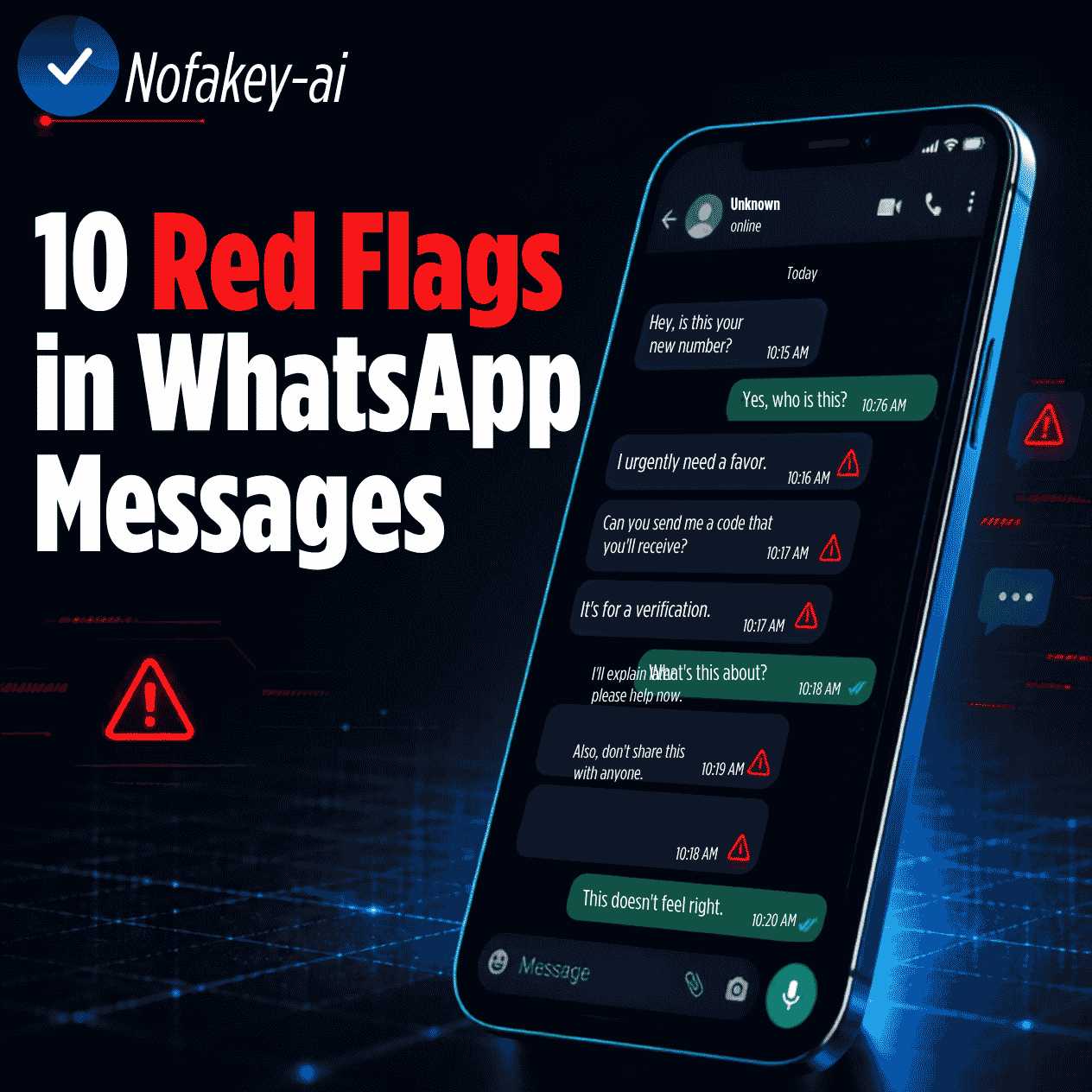
Your phone buzzes. It's a WhatsApp message. Maybe it's from someone claiming to be your child in trouble. Maybe it's a job offer that sounds too good to be true. Maybe it's a verification code you supposedly requested.
Stop. Don't reply. Don't click. Don't send anything.
WhatsApp has become ground zero for some of the most sophisticated scams in history. In just the first six months of 2026, Meta banned over 6.8 million accounts linked to criminal scam centers operating on WhatsApp [[1]]. Americans lost $2.1 billion to social media scams in 2025 alone, with WhatsApp ranking as the second-costliest platform behind Facebook [[6]].
The good news? Every single WhatsApp scam leaves fingerprints. Once you know what to look for, you can spot them in seconds.
This guide reveals the 10 red flags in WhatsApp messages that separate legitimate communication from dangerous fraud. We'll show you exactly what scammers do, why they do it, and how to protect yourself and your loved ones.
What You'll Learn
- Red Flag 1: Urgent Money Requests
- 🚩 Red Flag 2: Verification Code Requests
- 🚩 Red Flag 3: Suspicious Links
- Red Flag 4: Unknown Numbers
- 🚩 Red Flag 5: Too-Good-to-Be-True Offers
- 🚩 Red Flag 6: Grammatical Errors
- 🚩 Red Flag 7: Pressure to Act Fast
- Red Flag 8: Requests for Personal Info
- 🚩 Red Flag 9: Payment via Gift Cards/Crypto
- 🚩 Red Flag 10: Profile Inconsistencies
- 🛡️ Complete Protection Strategy
🚩 Red Flag #1: Urgent Money Requests from "Family" or "Friends"
1 The Emergency Contact Scam
What happens: You receive a WhatsApp message from an unfamiliar number claiming to be your child, sibling, or close friend. They say they've lost their phone, they're in an emergency, or they need urgent financial help. The message creates immediate emotional pressure.
Why it works: This scam, known as the "Hi Mum" or "Hi Dad" scam, exploits the most powerful force in human psychology: our instinct to protect loved ones. Scammers now use AI voice cloning to make their requests sound even more convincing [[1]]. In 2025, AI-related fraud reached 22,364 complaints filed with the FBI's Internet Crime Complaint Center [[1]].
How to spot it:
- Message comes from an unknown number
- Claims they've "lost their phone" or "changed numbers"
- Creates urgency with phrases like "right now" or "immediately"
- Asks you NOT to call them on their usual number
- Requests payment via gift cards, crypto, or wire transfer
🚩 Red Flag #2: Requests for Your WhatsApp Verification Code
2 The Account Takeover Trap
What happens: Someone messages you claiming they "accidentally" sent a verification code to your number. They ask you to forward it to them. What they're really doing is trying to register YOUR phone number on THEIR device.
Why it's dangerous: That 6-digit verification code is the master key to your WhatsApp account. Once a scammer has it, they can:
- Lock you out of your own account
- Impersonate you to ALL your contacts
- Send scam messages to your entire contact list
- Access your private conversations
Real-world impact: WhatsApp detected 10.9 million scam-center accounts across Facebook and Instagram in 2025, with account takeover being one of the primary goals [[1]]. Once scammers control your account, they turn one compromise into dozens of fresh targets.
🚩 Red Flag #3: Suspicious Links and Attachments
3 The Phishing Link
What happens: You receive a message with a link claiming to be from your bank, a delivery service, WhatsApp support, or a well-known company. The link leads to a fake website designed to steal your login credentials, financial information, or install malware.
The statistics: Scammers sent 19.2 billion spam texts in December 2025 alone — approximately 63 spam messages for every person in the U.S. [[3]]. WhatsApp has become a favorite channel because messages feel more personal and trustworthy than email.
Common variations:
- "Package delivery failed" - Click to reschedule
- "Bank account locked" - Verify to unlock
- "You've won a prize" - Claim your reward
- "WhatsApp Gold upgrade" - Exclusive premium features
🚩 Red Flag #4: Messages from Unknown International Numbers
4 The International Scam Network
What happens: You receive a friendly message from an unknown number with an international area code. Common ones include +234 (Nigeria), +91 (India), or other codes from countries where you have no connections.
Why they do this: Scammers use international numbers because:
- They're harder to trace
- They can operate from anywhere in the world
- A data leak in 2022 exposed nearly 500 million WhatsApp phone numbers from 84 countries, giving scammers massive target lists [[2]]
The "wrong number" strategy: Sometimes the scammer pretends to have dialed the wrong number. They strike up a friendly conversation, ask personal questions, and gradually build trust before introducing a fake investment opportunity or money request [[2]].
🚩 Red Flag #5: Too-Good-to-Be-True Offers
5 The Investment & Job Scam
What happens: You're contacted about an exclusive investment opportunity, a high-paying remote job, or a cryptocurrency scheme with guaranteed returns. The offers sound amazing: "$90,000/year working 2 hours daily" or "300% returns in 30 days."
The "pig butchering" scam: This is a long-con investment fraud where scammers build relationships over weeks or months, then guide victims to fake trading platforms. The platform shows growing balances, but when victims try to withdraw, they're told they must pay "taxes" or "fees" first. The money never comes back [[1]].
Job/task scams: Scammers pose as recruiters offering lucrative remote positions. After building trust, they ask you to complete "tasks" (like liking TikTok videos) and show you fake earnings. Then they ask for a "training fee" or "equipment deposit" before you can access your "earnings" [[1]].
🚩 Red Flag #6: Grammatical Errors and Unusual Language
6 The Language Tell
What happens: The message contains spelling mistakes, awkward phrasing, unusual word choices, or overly formal language that doesn't match how someone normally communicates.
Why it matters: While AI tools like ChatGPT have made scam messages more sophisticated, many still contain errors because:
- Scammers operate in bulk and don't proofread
- They're often working from scripts translated into English
- They're targeting thousands of people and don't personalize messages
However: Don't rely on this alone. Meta and OpenAI jointly disrupted scam centers using ChatGPT to generate convincing initial messages [[1]]. Some scams are now grammatically perfect.
Red Flag #7: Pressure to Act Immediately
7 The Urgency Weapon
What happens: The message creates artificial time pressure: "Act now or lose this opportunity," "Your account expires in 24 hours," or "This offer is only valid for the next 2 hours."
The psychology: Scammers use urgency to short-circuit your critical thinking. When you're panicked about a "suspended account" or worried about missing a "limited offer," you're less likely to stop and verify.
Common urgency tactics:
- "Your account will be deleted in 24 hours"
- "This prize expires tonight at midnight"
- "Only 3 spots left at this price"
- "Immediate action required"
- "Don't tell anyone about this opportunity"
Red Flag #8: Requests for Personal Information
8 The Identity Theft Play
What happens: You're asked to provide sensitive information: full name, date of birth, Social Security number, bank account details, passwords, or answers to security questions.
The danger: Once scammers have your personal information, they can:
- Open credit cards in your name
- Take out loans
- File fraudulent tax returns
- Sell your data on the dark web
- Use it for targeted phishing attacks
Real impact: The FBI's Internet Crime Complaint Center logged $20.877 billion in total reported losses across 1,008,597 complaints in 2025, with identity theft being a major component [[1]].
🚩 Red Flag #9: Requests for Payment via Gift Cards or Cryptocurrency
9 The Untraceable Payment
What happens: You're asked to send money via gift cards (Amazon, Apple, Google Play, Steam), cryptocurrency (Bitcoin, Ethereum), wire transfer, or payment apps with no buyer protection.
Why scammers prefer these methods:
- No reversal: Once you send it, the money is gone forever
- Untraceable: Harder for law enforcement to track
- Instant: They get the money immediately
- No verification: No ID or account required
🚩 Red Flag #10: Profile Inconsistencies
10 The Fake Identity
What happens: The person's profile photo looks professional or stolen, their status is vague or missing, they have no mutual contacts, or their "About" section is empty or generic.
Warning signs:
- Profile photo looks like a stock image or model
- No profile picture at all (default gray silhouette)
- Recently created account (check "Last seen" date)
- No status updates or "About" information
- Claims to be local but has an international number
- Refuses to video call or meet in person
Romance scams: These often start on dating apps but move to WhatsApp for privacy. The scammer builds a relationship over months, then introduces investment opportunities or emergencies requiring money. Nearly 60% of romance scam losses in 2025 started on social media before moving to private channels like WhatsApp [[1]].
🛡️ Your Complete WhatsApp Protection Strategy
Now that you know the red flags, here's your action plan to stay safe:
Immediate Actions
- Enable two-step verification: Go to Settings → Account → Two-Step Verification → Enable. This adds a PIN that scammers can't bypass even if they get your verification code.
- Adjust privacy settings: Settings → Privacy → Set "Who can see my personal info" to "My Contacts" only.
- Hide your profile from strangers: Settings → Privacy → Profile Photo → Set to "My Contacts"
- Enable app lock: Settings → Privacy → Screen Lock → Enable fingerprint or face ID
The PAUSE-QUESTION-VERIFY Method
Meta's official three-step test for spotting scams [[1]]:
What to Do If You Encounter a Scam
- Don't respond or click anything
- Block the number immediately: Open chat → Tap three dots → View Contact → Block
- Report to WhatsApp: Same menu → Check "Report Contact" → This sends the last 5 messages to WhatsApp for review
- Warn your contacts: If someone impersonated you, alert your friends and family
- Use our free checker: Paste suspicious messages into our AI-powered scam detector for instant analysis
If You've Already Been Scammed
- Contact your bank: Call immediately to attempt to reverse transfers or freeze accounts
- Report to authorities: File a report at ReportFraud.ftc.gov (U.S.) or your country's fraud reporting center
- Document everything: Screenshot all messages, payment confirmations, and contact information
- Change passwords: Update passwords for all accounts, especially email and banking
- Monitor your credit: Check for unauthorized accounts or transactions
📊 The Bottom Line
WhatsApp scams aren't going away. With 6.8 million scam accounts banned in just six months and $2.1 billion lost to social media scams in 2025, the threat is real and growing [[1]].
But here's the empowering truth: you now have the tools to protect yourself.
Every scam follows patterns. Every scammer leaves red flags. And every single one of these 10 warning signs is detectable if you know what to look for.
- ✓ Never share verification codes
- ✓ Always verify money requests through a separate channel
- ✓ Never click suspicious links
- ✓ Never send money via gift cards or crypto to strangers
- ✓ Enable two-step verification TODAY
- ✓ When in doubt, use our free scam checker
Remember: Legitimate organizations will never pressure you, ask for verification codes, or demand payment via gift cards. If something feels off, it probably is.
Stay skeptical. Stay safe. And when you're unsure, pause, question, and verify — every single time.
Got a Suspicious WhatsApp Message?
Don't risk it. Get a second opinion in seconds.
Check It Now — FreeNo signup required • Instant results • 100% free
Further Reading & Resources
Help protect your friends and family: Share this guide with someone who uses WhatsApp. Knowledge is the best defense against scams.